This page is a copy of the talk I gave at the Packrats meeting in November of 2002.  I have added a few notes and pictures to bring some of the information up to the 2026 present.


EME TALK (November 2002)

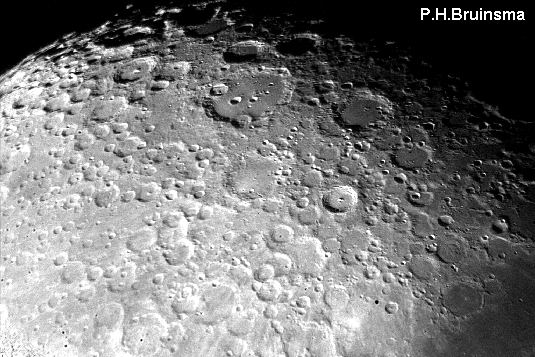
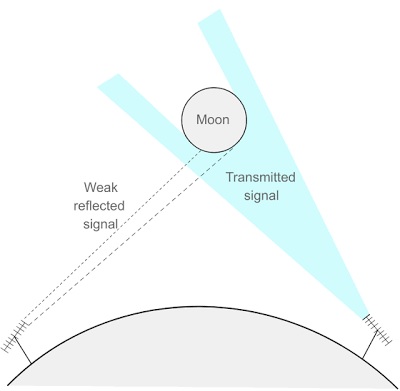
Hello everyone.  I’ve been asked to talk about amateur moonbounce tonight.  While I expect that everyone here knows what moonbounce, or EME operation is, maybe it wouldn’t hurt to start by defining it.  The surface of the moon can be used as a reflector for our ham signals.


If you send a signal towards the moon, and if you have sufficient antenna gain and receiver sensitivity, you can hear the reflected signal, or echo, coming back about 2.6 seconds later.  And anyone, anywhere on earth who can see the moon at the same time you can, will also be able to hear your echo. 


Thus communication is possible by sending your signal from Earth to the Moon and back to the earth at some other point.  Hams often refer to this activity as EME or moonbouncing.


My goal tonight is to get YOU interested in working EME from your home station.  I  think that most hams think EME can only be worked with exotic and expensive equipment, huge antennas, and very high power.  Tonight I’d like to show you that you can enjoy the thrill of amateur moonbounce communication with a much more modest setup.  Many of you can work EME with the equipment you already have while others may need to make a small investment of time or money to do it.


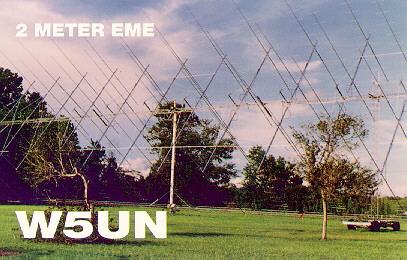
This is the monster 2 meter EME array created by Dave, W5UN.  I could work him on SSB with my 4 Yagi station.


Let’s start by talking about why you would want to work amateur moonbounce.  For myself there is one main reason; it is exciting!  To me the most fun in ham radio is when actually making a rare, unusual, or especially difficult contact.  For example, imagine working a 300 watt station with small antennas in Estonia, or being able to chat briefly with friends in Europe on a daily basis on two meters.  Amateur EME allows you to work worldwide DX on virtually any amateur band from six meters up.


For those of you who have been chasing grid squares for a few years and find that it is hard to find new ones, EME is an excellent way to find some new action.  Some of you may enjoy the pursuit of various awards that are offered for station achievement.  In addition to VUCC and endorsements, it is possible to work WAS, WAC, DXCC, and other specialized awards on the VHF bands by utilizing EME.


Perhaps the ultimate example of this is in the award won by our friend Al Katz, K2UYH, in 1981. (50MHZDX).  He was one of the first winners of the coveted “50 MHZ DX” award from Japan.  This award was intended to reward any Ham who manages to work 10 or more JA’s on six meters.  However the qualifications for the award say “for contacts made above 50 Mhz”.  Al applied for and received the award by working 10 JA’s on 432 Mhz!


I know a lot of you like to contest.  There are a number of contests just for EME.  The most popular one is the ARRL International EME contest which is held for two weekends, in October and November of each year.  The November weekend is coming up, tomorrow night, starting at moonrise, 7:00 PM local time.  Aim your antenna at the rising moon and see what you can hear.  Tune 144.010 through 144.050 or so for stations calling CQ on CW.


Other contests are the European World-Wide EME contest in March and April, the Italian EME contest later in the year, and a specialized one, the 1296 SSB EME contest.


My EME background

Next I’d like to give you a little background on myself as regards my EME experience, and tell a couple of stories.  I think the first time I became aware of moonbounce was as a teen-ager when the first amateur EME contact was made.  The cover of QST for September, 1960 proudly announced “Coast to Coast Via The Moon on 1296 Mc”.
 

My 17 year old imagination was captured!  For the next 25 years EME was my dream.


But I was unable to do anything but dream about it for a number of years.  My first EME experience was on September first, 1973, when I had a good VHF station at the top of a ridge in Western NY.  One day I looked at the VHF column in QST and noticed an announcement that two stations had a schedule to work EME on two meters on that date.  I made the 25 mile trip to my remote QTH that night to see if I could hear anything.  My QTH was near Mayville, NY, atop a high ridge that runs parallel with Lake Erie. Standing at the base of my tower and looking west I could see the lake, ten miles away and 1250 feet below!  At the appointed hour I had the station all warmed up and tuned to 144.080.  I went outside to see if the antenna was pointed at the moon.  The full moon was setting in the west, over the lake.  Looking up I could see the elements of the pair of 15 element yagis atop my 60 foot tower reflecting the moonlight.  The moon’s reflection made a broad trail of light on the lake as far as I could see and my antennas seemed to be pointing right down that trail leading to the full moon!


I could clearly hear the weak CW from the station in Long Island, NY off the back of my antennas as he made the initial calls.  W6PO W6PO W6PO de WA2BIT WA2BIT WA2BIT, over and over for 2 full minutes.  Even hearing a 6 call on 2 meters was exciting for me then.  Then came the turnover and I listened closely in the headphones to the noise coming from my SB301 receiver.  At first I heard – nothing.  But what’s that?  About 500 hz lower in pitch I started to hear - some CW?  It takes a few seconds to get your ears accustomed to a different pitch of a weak signal, but sure enough I started copying “de W6PO W6PO W6PO”!  WOW!  I was thrilled beyond my imagination.


My mind went into overtime.  Maybe I can work him!  Yeah, I’ll wait til they are done and then tail end.  I’m on the right frequency, all I have to do is press the key. OhOh, what if I hit the key by mistake, or get over-anxious and start sending too soon?  I don’t want to QRM such an important contact!  Quickly I reached over to the Heathkit SB401 transmitter and turned the band switch from 10 meters to 80 meters.  There, now there is no way I can start transmitting until I am sure I am ready.


I listened to the whole contact.  Copy was quite good at times.  Finally I heard 73’s.  Frantically I grabbed the straight key and started sending.  W6PO W6PO W6PO de K2TXB K2TXB... what?, I hear the side tone, but no power output showing on the bird!  What’s wrong.  Key the rig, idling current, but no drive – what the heck???  The tubes are all lit on the transmit converter..?? Check all the wiring and connections, everything looks good.


Well in my excitement I completely forgot about the exciter being on 80 meters.  I sat watching the moon disappear over the lake wondering what could have possibly gone wrong.  I guess it was 5 minutes later that I finally realized.


I felt a little foolish but not too bad.  I had actually heard a famous W6 station on 2 meters!  I think I was floating 10 feet above the road on the drive home.


Bob Sutherland W6PO, Eimac, Amplifiers, Preamps

Barry Forrest N2MB (ex WA2BIT)


EME WITH K2UYH

But it wasn’t until 1983, after I moved to New Jersey that I finally made my first EME contacts.  I spent quite a few happy hours every year operating the ARRL EME contests with Al, K2UYH using his 28 foot dish on 432 and 1296.  That was a lot of fun, and hearing 1296 stations in Europe and Japan on SSB like they were here on the east coast was certainly another thrill.  The high point of my operations with Al was on May 9, 1987.  We decided to do a special and put his dish on 2304.  Al Katz K2UYH, Andy Furlong WA2FGK, Bill Ashby K2TKN, and myself were the crew that weekend (CREW).

Andy brought a solid state 100 watt amplifier that was a work of art, and virtually unheard of on 2304 in those days.  We mounted the amp right at the dish feed (FEEDa,b).  I got elected to do all the actual operating, and I didn’t complain a bit!  Al kept busy making sure the equipment was working while the others sat outside in the sun listening on a remote speaker, and kept the dish on the moon via bore sights affixed to the dish.  I communicated with them via a 2 meter HT.


For hour after hour, every time I ended a transmission, the S-meter would indicate S9 for a second or so as our echo returned to us.  If it did not, I’d grab the HT and say “We’re off the moon again”.  Sure enough in a few seconds the echo would be back to S9.  Those echoes in themselves were exciting, but we made some great contacts too!  To name a few notable ones: OE9XXI, OK1KIR, F2TU, and W4HHK (111,112,113).


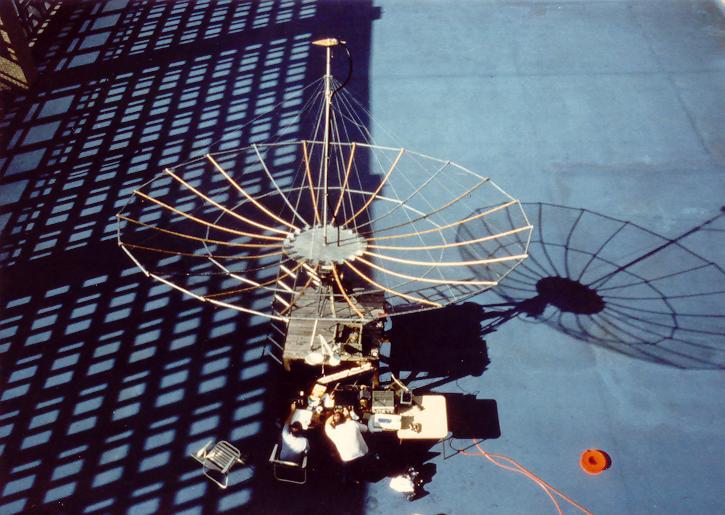
Another great project with Al was the 4U1UN expedition.  On August 6, 1988, Al, myself and two others hauled a 432 EME station including a 20 foot dish up to the roof of the United Nations building in New York City.

We actually “camped out” there for the weekend, working EME when the moon was up and the August UHF contest when it was not.  Now how many people can say they have camped on top of the UN building!  I told you EME is exciting!


Operation from Home


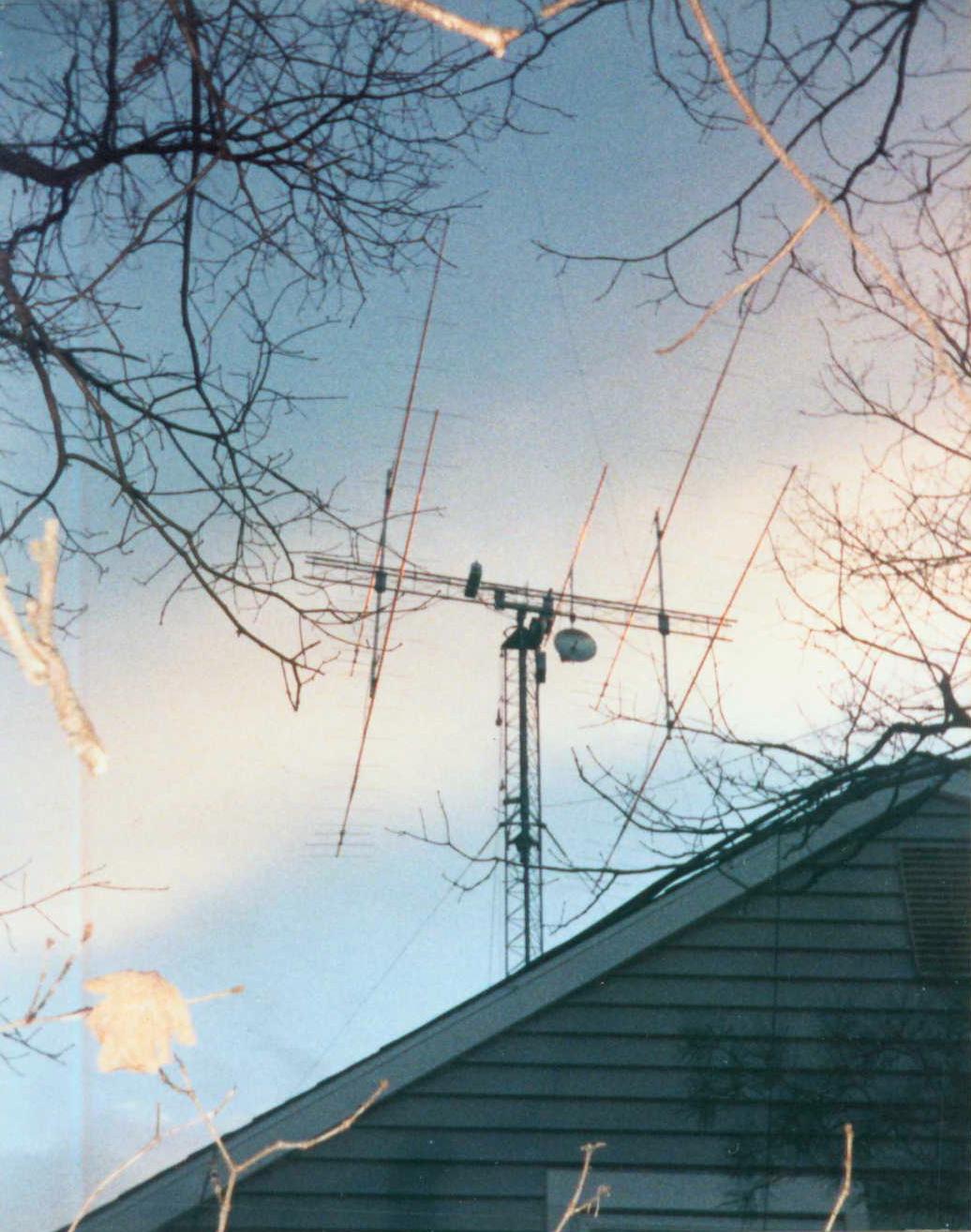
I also got on EME from my home QTH during the eighties and finally started working my own moonbounce.  I put up 4 16 element KLM antennas on a 60 foot tower.


With that setup I worked all states and all continents on 2 meters.  A lot of the QSL cards are in the two books on the table for anyone who in interested in what can be worked with such a station.  The small book is for foreign QSL’s and the large one for stateside.


All good things eventually end and my EME array was taken down in the late nineties.  The trees at my home QTH had grown to the point where the bottom antennas were completely blocked, making the antennas useless for tropo, and the 9913 phasing lines were finally starting to give out.  I replaced the antenna with the current single M2 8WL Yagi at 100 feet (ANTENNA).  With this antenna I can work CW EME when the moon is on the horizon, quite easily at times.  However there are times when it is impossible due to the noise pollution that has invaded southern NJ over the years.


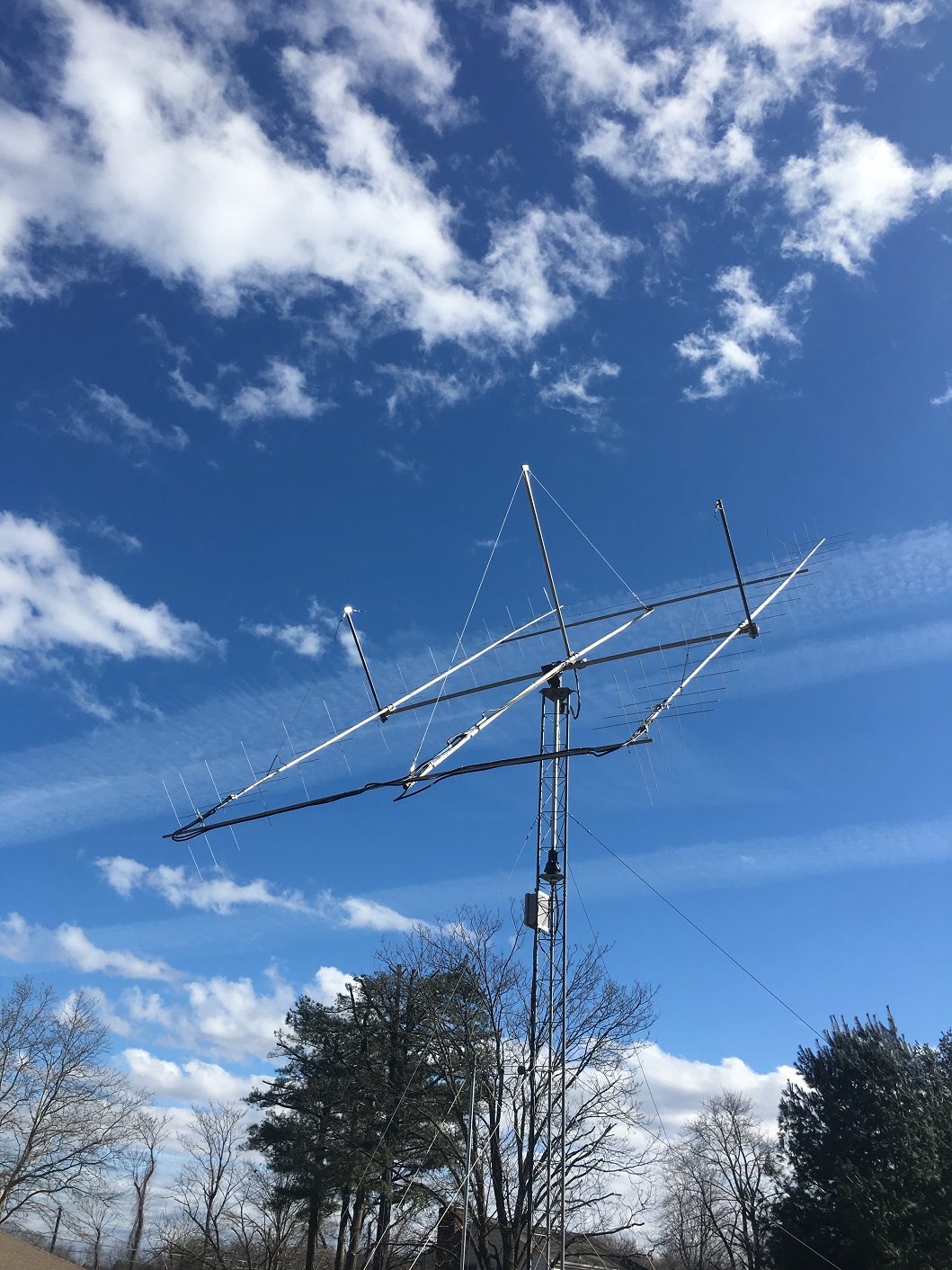
Here are my 2 meter EME antennas as in 2026.  Having finally worked over 100 countries on 2 meters, I plan to take them down this year, and perhaps get started on 1296 EME.


This is a pair of M2 cross polarized 28 element Yagis (14 elements in each plane).  They are an advanced design and provide significant noise reductions over older designs by reducing the strength of side lobes that can pick up local noise. 


Digital EME

Note that this talk was given in 2002.  Since then a tremendous amount of changes have been made to the digital mode capabilities, as well as in amateur EME.  But the narrative below is still useful as a review of digital moonbounce history and practice. 


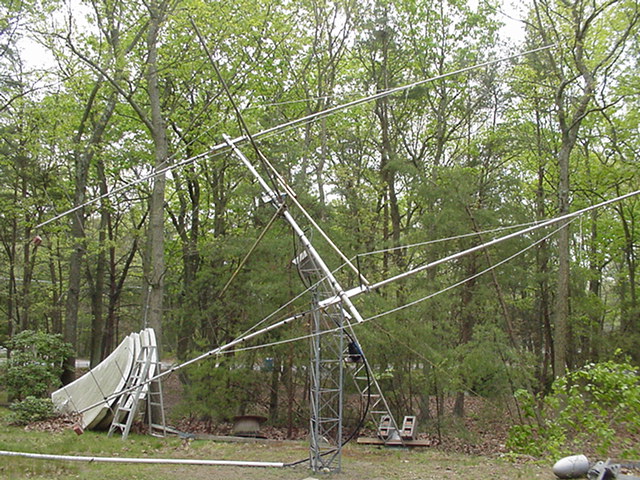
When K1JT invented the JT44 mode early this year, I was thrilled to discover that I could make EME contacts almost any time the moon was on the horizon.  But I wanted more, so I resurrected two of the old KLM 16LBX antennas from behind my woodshed, and built a small EME array.  Polar, or equatorial antenna mounts are commonly used for dish antennas, but I had long wanted to try a polar mount for Yagi antennas on 2 meters, so I decided to build one.

The result is shown in pictures on my web page and here. With this modest setup I have worked 42 different stations in 15 countries and 15 states in the 9 months starting in March 2002.  Many of the stations have been worked multiple times.  Being able to aim the antennas up, besides allowing operation when the moon is above the horizon, gives a tremendous advantage in reduced man-made noise.  Another benefit is no TVI.


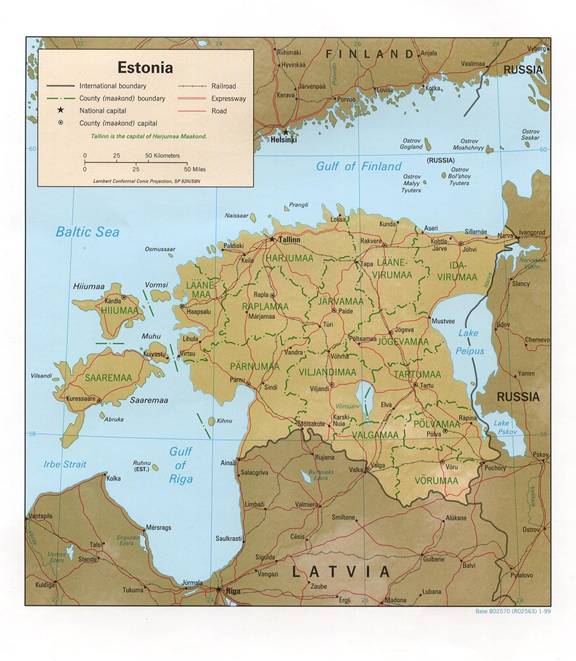
But the biggest asset to the station is JT44.  It provides the capability to work stations under conditions that are totally impossible on CW.  Perhaps the best example of that is ES8X.  This was a field day expedition to the island of Kihnu, KO18xc.  Kihnu is a small island about 40 km off the coast of Estonia in the Gulf of Riga, between Estonia and Latvia.  Their station was 300 watts to a pair of 9 element Yagis, fixed on the horizon.  The operators were not familiar with EME, so the first try was a bust due to scheduling when the moon was too far above the horizon.  The next day we tried on their moonset.  I never heard their signal, but the signal averaging feature of JT44 allowed me to get full calls, reports, rogers, and even 73’s from them.


Current EME practice (in 2002)

Currently there are two ways that EME is worked by amateurs.  The first is the conventional way, using CW and/or SSB.  I still make a few CW contacts now and then but I find my greater interest is to see what I can do with the new digital mode.


Of course the other mode is digital. Today, for EME, there are only two digital modes in use.  One is called PUA43 and the other one is JT44.  PUA43 was invented by Bob Larkin, W7PUA and it works by sending fixed frequency tones that can be detected by a digital signal processor.  A unique tone frequency is assigned to each letter of the alphabet and each numeral and punctuation character, 43 tones in all.  Using DSP techniques combined with very long transmission times, it is possible to dig way down  into the noise and retrieve signals that are undetectable to the human ear.  The way PUA43 is able to find the signals is by knowing the exact frequency that each letter will be on. Thus it is able to establish an extremely narrow bandwidth filter for each possible character, and integrate the received signals over time.  The more  time allocated to a message, the weaker the signal can be and still get good copy.  For example it is possible to get 100 percent copy of a standard EME message, on a signal that is 39 db below the noise in a 2400 Hz passband.  It takes 4 hours to do this.  Some pretty amazing contacts have been made using this mode.  For example EME contacts on 1296 using 5 watts to a TVRO dish at each end, or 150 watts to a single small Yagi at each end of a two meter EME path.


PUA43 is only able to work if the precise frequency and timing of the transmitter is known to the receiver.  Frequency accuracy of about one hertz is required, and of course that accuracy must be maintained for the duration of the contact.  Thus specialized equipment is required, using techniques of phase locking all oscillators to a highly accurate frequency standard.  The most common hardware setup is called the DSP-10 transceiver, a hardware/software combination.  For those interested in the somewhat esoteric PUA43 mode, there are many references available on the internet.  Just do a search on PUA43.


When Joe Taylor, K1JT, developed the JT44 mode, he used some of the techniques of PUA43, but with some important differences.  Those differences make it easy for most amateur VHF gear to be used to make digital EME contacts without the stringent frequency and time requirements of PUA43.  A primary difference is the addition of a 44’th transmission tone that is used for synchronization purposes.  Hence the designation of JT44.  Using the sync tone and some advanced synchronization algorithms, Joe was able to provide most of the benefits of PUA43 and still allow for normal SSB transceiver frequency inaccuracies.  For instance your rig can be up to 600 hertz off the assigned frequency and JT44 can still find and decode the signal.  Timing requirements are likewise reduced. It is possible to work stations whose clocks are within 3 or 4 seconds of yours.


The price for this relaxation of accuracy is a lesser degree of weak signal detection.  But JT44 still does very well.  It is possible to work stations that are down to about 32 db below the noise in a 2400 Hertz passband.  The receive part of the program searches for the sync tone, which is turned on about 50% of the time in a pseudo-random sequence that is known to the program.  When the sync signal is detected, the program then knows what the frequency and time relationships of the transmitter are.  It can then set up filters at each frequency where a character tone would be transmitted, and dig under the noise to determine if those tones have been sent or not.


Each JT44 transmission consists of a 22 character message that is repeated 3 times in a 30 second transmit sequence.  At the end of the reception period JT44 displays the average of the characters received in each time slot of the 22 character message.  When the signal is reasonably strong, say only 17 db below the noise, it is often possible to get full copy of the message from a single transmit sequence. You can read the message right off the screen.


But often the signals are weaker and the message from a single sequence will be garbled.  This is when the wonderful averaging capability of JT44 comes into play.  As long as the sending station continues to send the same exact message on each transmit sequence, JT44 will average the results of all the transmissions, and display the result in a separate text box on the screen.


So, even though you may be unable to read the message immediately, in the average box, the message will gradually appear as time goes on.  It’s often just a matter of waiting long enough for the averaging to work.  Eventually the call signs will appear.  Of course once the calls are received, you will start sending reports, and eventually rogers and 73’s, restarting the averaging with each new message.


Station Requirements

So, what is required to work EME with JT44.  Well as usual, the answer has to be “that depends”.  It depends partly on what ham band you wish to work, partly on the level of difficulty you are willing to accept to make contacts, and on how many stations you would like to work.  For instance if you would be content at first to just work a few of the bigger stations on two meters, you can get by with a very modest station.  If your aim is WAS or DXCC you will want, eventually, to have more power and antennas.  I’m going to concentrate my remarks on 2 meters since that is where I suspect most people might start out.


Let’s start with the antenna.  One of the most important aspects of situating a VHF antenna is to get it up in the clear, above buildings and trees.  But for EME, all you have to do is be able to see the moon.  If you can see the moon as it rises or sets, that is good because you can take advantage of a phenomenon known as “ground gain” to give your signals a boost.  But if you are surrounded by trees or buildings or hills, you will need to provide a way to elevate your antenna to point to the moon when it is high and in the clear.  So, even if you live in a poor VHF location you can work moonbounce.


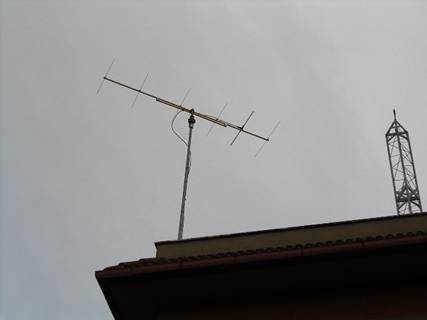
How big does the antenna need to be.  Well the standard answer is that if your antenna stayed up last winter it wasn’t big enough!  This can be true for moonbouncing too, “the bigger the better” always holds, but a small antenna can be used for serious EME work.  For instance I have copied signals from a station in Italy who was using a 6 element Yagi for 2 meters.  He was running 800 watts and I am sure I would not have copied him if he was using a brick amplifier, but remember that I am only using two 16 element Yagis myself.  He could and did work stations who had 4 long Yagis.  Here is his antenna.


I was unable to work him because he could not hear me, even though I run high power.   The reason is that he lived in the city and had a high noise level on the horizon.  He could not elevate his antenna, and the antenna had little directivity to reject the noise. If he had a quiet location, I’m sure we would have worked.


My advice is to strive to start with at least a single medium to long Yagi, or a pair of short Yagis (9 to 13 elements).  If you already have such an antenna or a larger one then you are in business.


If you wish, you can work EME only when the moon is near the horizon, taking advantage of ground gain to increase the signal from a small antenna.  But this requires a clear shot to the east or west, on the horizon, and it does restrict your operating time significantly.  A better plan is to add elevation control to your antenna.  A discussion of elevation rotators is beyond the scope of this talk, but several manufacturers make suitable hardware for this, or you can build you own.  The World Wide Web is an excellent source of information on both commercial hardware and plans for the homebrew enthusiast.


And, although I built and have shown a polar mounted antenna system using Yagis, I would recommend a az/el system in most situations.  It will require a smaller ‘footprint’ in your back yard, and it is easier to build from standard parts.  If anyone does want to build a polar mount for their antennas I will be happy to discuss it with you.


Polarization Considerations

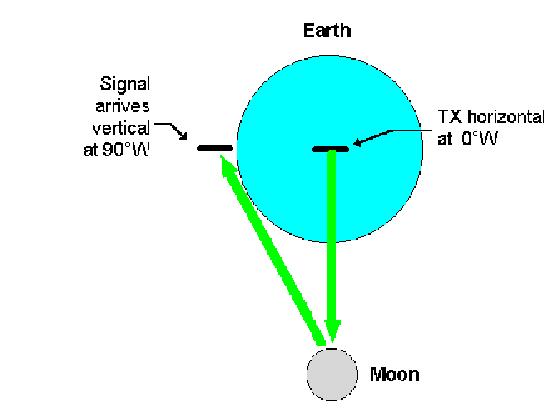
When you are working tropo contacts on VHF, all of the signals you hear are pretty much horizontally polarized.  But due to the geometry of the earth-moon-earth path, the signals are very often rotated to some other polarity when they arrive at the receiving antenna.

In addition to geometric rotation, there is a phenomenon called “Faraday Rotation” that randomly changes the polarization in an unpredictable manner.  So, it is often impossible to hear a signal, or your own echoes, although they would be quite copyable if your antennas were rotated to the correct polarity.


There are a few ways to deal with this situation.  One is to use circular polarized antennas.  This will reduce the gain of your array by 3 db, but you will never experience a problem due to incorrect polarity.  Another way is to use crossed Yagis and switch the polarity around until you determine the optimum setting.  This is sometimes difficult but can reward you with contacts when it would otherwise be impossible.  You can also use rotatable antennas like mine, but it takes time to rotate and the mechanical configuration on two meters is challenging.


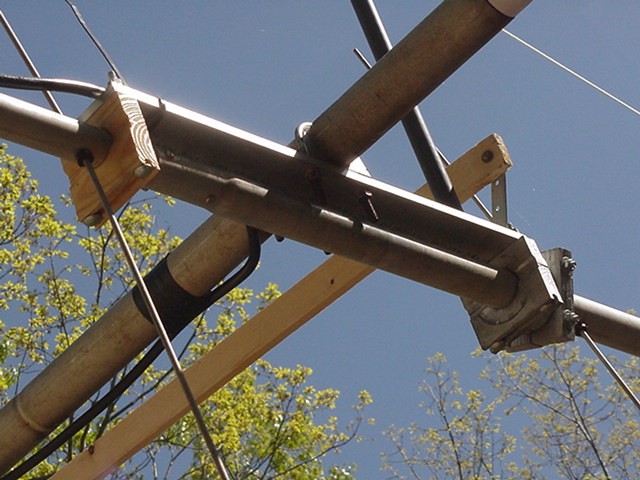
This is the rotation mechanics of one of the pair of Yagis on my polar mount array.  You can see the home made bearings and the push/pull mechanism with a wood stick (later replaced with something that would not warp!).


For more details see: Polar Mount 2 meter EME Array


I think the crossed Yagi is the best answer, but there is a simpler way.  Especially on two meters, the faraday rotation is almost always changing.  Many times all you have to do is wait and the signals will finally be heard.  Sometimes there is an additional problem though, in that the rotation is not reciprocal.  When you can hear your sked partner, he does not hear you, and vice versa.  So, you have to wait some more for the faraday to change back so he can hear your report.  All this means is that instead of making your contact in 15 minutes or less, it may take 45 minutes to an hour.  Most two meter EME operators do use horizontal antennas and play the waiting game.  When the faraday favors them, they hear as well or better than anyone else.  So, if you are building a new array for EME, consider using crossed Yagis.  Otherwise use your horizontal Yagis and you can still make lots of contacts.


Other Equipment

Another very important antenna consideration is feedline loss.  Since EME antennas do not usually have to be high, you can often use very short feed lines.  Still, you need the best receive sensitivity you can get, so even on 2 meters with a short feed, a preamp at the antenna is highly recommended.  There is one exception, if you only work 2 meter EME on the horizon, and if you have a short feedline, then a preamp in the shack is sufficient.


Another advantage of the preamp at the antenna is that you do not need very low loss feedline.  You can make up the difference by increasing transmitter power.  Of course it may be cheaper to buy better coax than a bigger amplifier.


Speaking of amplifiers, how much power do you need?  To give yourself some reasonable amount of ease in making contacts, I would recommend that you strive to start out with at least 300-400 watts.  You can make contacts with the 160 watt brick, but they will be more difficult and with only big stations.  With a single 9 element Yagi and 160 watts there are probably 50 stations in the world you can work on 2 meter EME, but it will take you a long time to work them all.  By upgrading your station from small to modest, it becomes possible to make contacts more often and that is more fun - unless you most enjoy the challenges of QRP operation.


I mentioned receiver sensitivity before.  I just want to add that a good low noise preamp is a must.  The preamp in your transceiver or brick amp is not good enough.  Get an external preamp, and be sure to get one with relays that can handle the power you will be using.


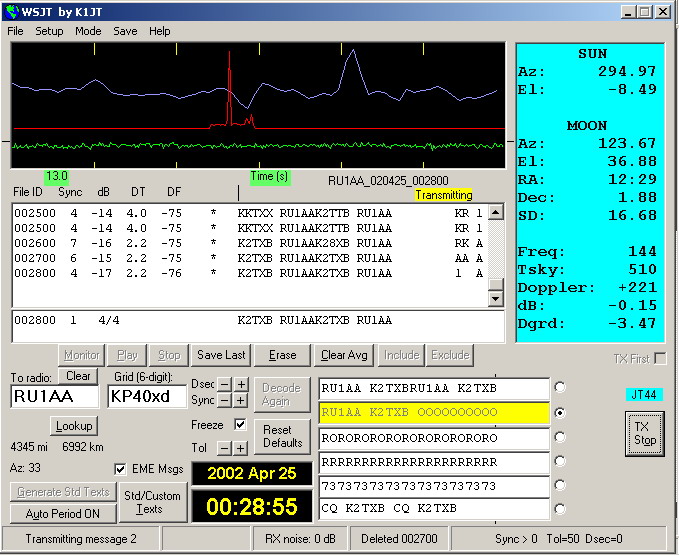
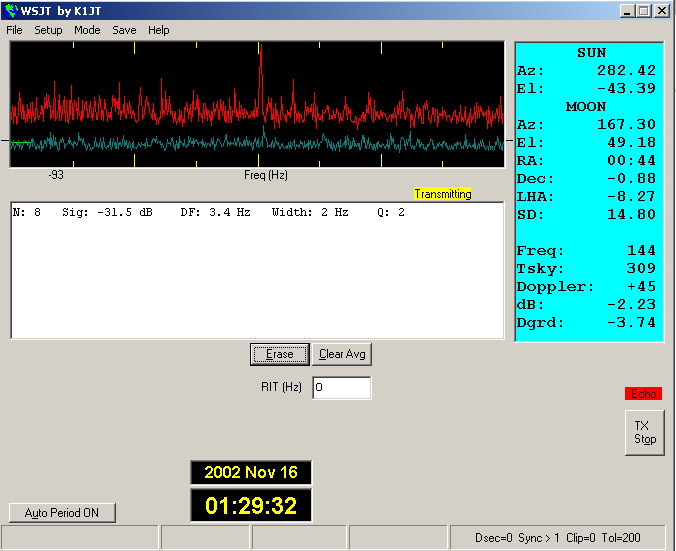
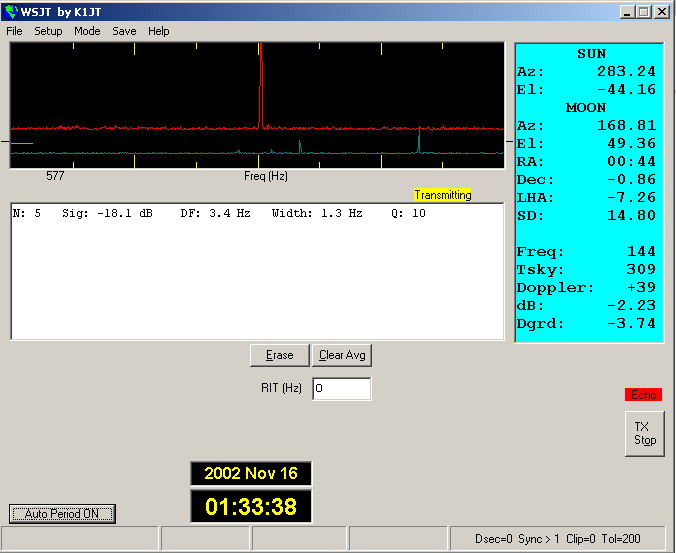
There is now a good way for you to determine if your station is working well.  JT44 echo mode.  If you can copy your own moon echoes it is a sure bet that others will be able to copy you and you them!  Until the advent of JT44, moon echo testing was restricted to high power stations.  But JT44 can detect even low power echoes from your station when moon conditions are good.  Like normal JT44 reception, echo mode uses digital signal processing and averaging to detect signals below the noise.  I can often detect my echoes when running just 50 watts in the shack.  If you cannot detect your own echoes it is time to work on the station to see what is wrong.


Below are two screen shots, showing echoes received at my station.  The tall vertical red line at the center is the echo.  The first picture is at 100 watts output.


Now here is the same test with 1500 watts output.


The last RF hardware issue is frequency stability and accuracy.  While JT44 does not have the stringent requirements of PUA43, you still need to be reasonably close to frequency and reasonably free of drift.  Fortunately you can get a close enough calibration check on the air from locals who know their frequency, and then calculate the necessary offset from your readout.  Of course a VHF frequency standard is very handy.  If your rig has significant short term drift, it can make JT44 and CW contacts difficult.  Get it fixed or get a new rig.


Computer Control

You need a computer that you can dedicate to the task of running JT44, and controlling your transmitter.  The computer needs to be able to run one of the 32 bit versions of the Windows operating system, and should be fast enough to handle JT44 and several other tasks at the same time.  A 300 Mhz Pentium or better, running Windows 98 or preferably Windows 2000 or XP will be sufficient.  In addition to the JT44 program, it is convenient to also run a program to keep your computer clock accurate via an internet time standard.  However you can also manually watch your clock and set it from WWV or your local time standard as needed.  Although JT44 can work with time offsets of up to 3 or 4 seconds, when running EME the requirements are more severe due to the 2.6 second EME signal delay.  Keeping your clock accurate within a tenth of a second is fairly easy with software such as the Dimension4 program that is available for free.


Finally, you will need an interface between your computer and your ham station.  I built my own, using parts commonly available at Radio Shack, at a cost of around 10-20 dollars.  You can also buy commercial hardware designed for the job.  The Rig Blaster, produced by Del, K1UHF’s company, West Mountain Radio, is one example that is in common use.  Cost was somewhat over $100 last I knew.


Whether you build or buy, you will end up with several connections between your computer and your radio.  The radio’s PTT line must be activated via a control line from a serial or parallel port on the PC.  A channel of the audio from the sound card in the PC is fed into the microphone input, or into an auxiliary audio input in the back of your rig.  And the audio output from the receiver is fed to the mike or line input of the sound card in the computer.  The audio connections are usually fed through transformers or other matching or coupling devices, and there may be a provision to set levels, although levels can be set from the software mixer panel in the computer.


Once the levels are set properly and PTT operation verified, you are ready to run.  Before jumping into the fray with your first EME contact, however, I’d advise making several contacts with locals to familiarize yourself with your new hardware and software.


There is other software available that you may want to use for additional signal processing, tracking the moon, scheduling EME contacts, and clock control.  Here are a few of these programs.


 Software

1.   DSP Software (Spectran, FFTDSP) https://www.sdradio.eu/weaksignals/spectran.html      

2.   Tracking software (DrzTrack, Z-track, Skymoon, MoonSked)
http://www.w2drzcontrollers.k2txb.net/
https://www.g1ogy.com/www.n1bug.net/software/ztrack.html

     http://www.gm4jjj.co.uk/MoonSked/moonsked.htm

3.   Scheduling software (VK3UM, SKD87)

4.   WSJT: https://wsjt.sourceforge.io/wsjtx.html

5.   Timing software (Dimension4): http://www.thinkman.com/dimension4/


EME Fraternity

So, now that you have your station set up and checked out, how do you go about actually scheduling and making contacts.  Well there is a large fraternity of EME stations that have been anxiously waiting for you to get on the air, and they are very willing to help you get started, make schedules with you and even talk you through your first contact or two.  Most of this is done via the internet in various ways.  There is a reflector dedicated to EME, called moon-net.  There are two good web pages dedicated to real time scheduling of EME contacts.  One is the EME activity logger, and the other is the JT44 EME link page.  On the JT44 page, you can find fellow hams looking for schedules, making them, or comparing notes after the contact is complete.  Even if you do not wish to frequent the internet for this purpose routinely, it would be helpful to start out doing so, because of the degree of help you can get.  Once you have learned the ropes, you may wish to resort to making schedules via email or regular mail, or you may want to revert to totally random activity.  Here are the internet addresses of the mailing list and web pages.


Moon-net: (https://groups.io/g/Moon-Net)

JT65 EME Link: (http://www.chris.org/cgi-bin/jt65emeA)


You may prefer random to scheduled activity, but remember that we are often working with signals that cannot be heard.  It is not easy to tune the band, looking for such weak signals.  That is why most activity is done by skeds.  However there are a few stations that are so active that they have known frequencies, they just get on and call CQ and they get answers.  An example is S52LM in Slovenia.  Milos calls CQ on 144.169 almost every day.  On 432 there is an international JT44 “calling frequency”, 432.044.  No such frequency has been established for 2 meters or any other band as yet.


I suppose I must say something about the requirements for a valid contact.  Most all contacts made via ham radio are on the “honor system”.  If you say you made the contact, or if you can produce a QSL card, it is accepted.  But the ARRL and others have published the minimum requirements for a contact and it is up to each operator to decide whether or not his contacts meet these requirements.  The requirements are:

a)   Both stations must receive both call signs completely.

b)  Both stations must receive some kind of a report or other information (such as grid square).

c)   Each station must receive an acknowledgement that his calls and report have been received.

d)  All of this communication must take place in one continuous attempt, with no information about the contact being exchanged via any other means during the attempt.


I want to emphasize point D a little.  Since we often use the internet to set up skeds, and to compare notes afterwards, it is a big temptation to chat during the course of a contact, especially if things are going slow or you are having trouble.  While it’s ok to chat about equipment or chat with others, it is not ok to tell the station you are attempting to work what you have heard or what you are sending.  And if you do, or he tells you, it is necessary to start the contact over again as if nothing has yet been copied.


Please remember that a lot of people may be watching and learning from your example.  If you engage in comments like “I got the calls and I’m sending reports now”, it can make others doubt the validity of your claimed contacts and it can also lead others who do not know better to do the same thing.  I would hate to see the wonderful internet tool, that we have, be used to abuse our ham contacts this way.


In Summary, I’m encouraging and welcoming each of you to join the ranks of active moonbouncers.  It isn’t all that difficult any more and the rewards are many.  If you sit with your receiver glued to 144.200 or other calling frequencies, waiting for band openings, how much DX do you get to work?  Even if you actively call CQ every day and work stations, most of the time you will be working local stations within a few hundred miles.  But if you actively pursue EME, you can work worldwide DX on a regular basis.


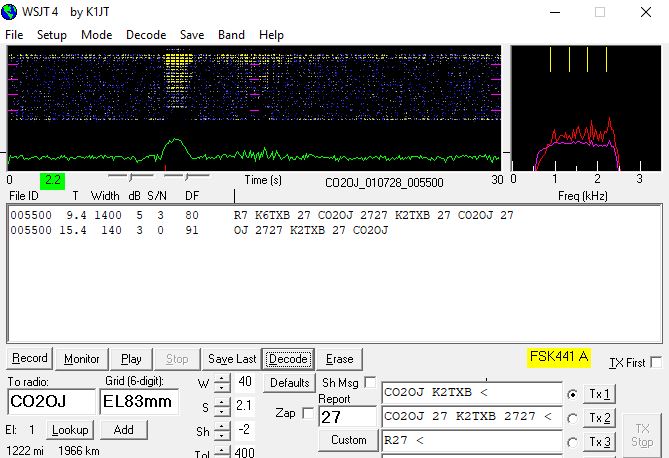
In closing I also want to mention that the JT44 mode is part of  a larger program called WSJT.  With WSJT you can also work high speed meteor scatter, a mode that too, will permit you to work DX up to 1200 miles or so on a daily basis (CO2OJ).  By combining EME and meteor scatter you can work 2 meter DX almost any time you wish.  My log for the past year is on the table if anyone wants to get an idea of just what can be worked.  (Click here to view log pages.)


73 to all, and Good DX’ing - de Russ K2TXB